Week 6: Ideation I
- May Druyan

- Dec 14, 2019
- 3 min read
Updated: May 4, 2020
This week we moved to the ideation step.
This is the step where we need to process everything we heard, seen, and gathered, to a lot of ideas. In this step, we use no judgment, to produce a wide range of solutions.
We started by placing on top of the board, our question of "How might we?". We chose to focus on "How might we close the technological gap between the young and the elderly?"
Then, we named out loud every possible solution we have to our need, remembering our main lead question. To every idea, we added post-it notes on the board and on top of that, we went into details with more notes. Each of the notes meant to characterize and extend the solution.


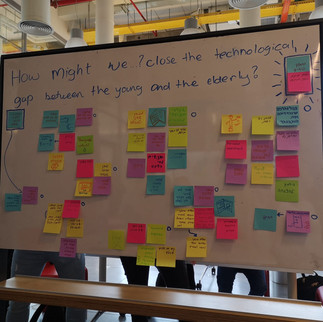


After we had all of our solutions on board, we created categories, in order to characterize and categorize our solutions better.
The categories we chose are:
1. Community-based learning
2. Mutual learning
3. Self-guidance
4. Non-technological
5. For young people


The categorized solutions are:
Community-based learning
- Digital interactive guidance book - It is a two-way platform - the users can ask for help, and the users can upload videos of themselves solving an issue, in order to help the users community. The book contains solutions that could guide the elderly to solve their problem, and could save history such that used solutions will be on quick accessibility.
Mutual learning
- Language tutoring - We noticed that seniors know many different languages, and could pass this knowledge to the younger generation. In the taught language, young people could explain to the seniors about technology.
- Give and take - Seniors have major life-experience and knowledge that young people don't necessarily have, while young people have knowledge about technology and its usage. That is how we can make knowledge "give and take": the seniors could teach the young experience-based and knowledge-based techniques and information, while the young could give back by their experience and knowledge in technology.
- Professional Tinder - A non-technological interface that seniors could use to ask other seniors for help. Each senior in the app will have a profile and his proficiency, such that the user could filter professionals by their specialty. It could look like newspapers with the "careers" section.
Self-guidance - Guiding Hologram - This is a universal hologram that can speak in every language and adapts itself to all kinds of devices. The user can operate the hologram using his voice and could be as a personal assistant.
- Technological SOS button - Order technological helper using a simple button.
Non-technological
- Seniors as babysitters - Each user will have a profile, the user could filter by radius and availability. Seniors could be babysitters to children.
For young people
- Vintage clothing app - A platform that connects young people that want to buy vintage clothes, and seniors that want to sell their clothes. The user can filter by location, price, fabric type.
Then, we created a flow of our persona, such that we could understand the context that the solution is interacting with. We did this by creating a timeline that looks like a map, since a lot of situations can lead to each other, and this not a direct timeline.


Then we got to our final Timeline:

It starts when our persona gets up in the morning and having coffee.
Then there are multiple scenarios, but all lead to the same scenario - where he or she waits for the call from the family.
In order to understand better, we dramatized this exact situation, with our talented Lior, that played our persona, and Vered, that played a family member.

This dramatization led us all to emotions and got us to think about what can we do for our seniors.
After having a discussion of the solutions we came up with, we decided to focus on:
1. Digital interactive guidance book
2. Give and take
3. Guiding Hologram
In our opinion, those are the solutions that will make the most impact.
For each chosen solution, we will describe how it fits in our context, which is the moment the elderly wait for a call from the family.
To demonstrate it best, we sketched the scenarios according to a detailed flow.
Interactive guidance book

Give and take




Guiding Hologram



Comments